
Study changes, change everything: How Impact Analysis in Tryal Accelerator Eliminates the Chaos of Downstream Document Updates
- Shae Wilkins
- Mar 5
- 6 min read

TRYAL ACCELERATOR | FEATURE DEEP DIVE
Shae Wilkins | March 2026 | 6 min read
The Ripple Effect of Change
Clinical trials don't stand still. Protocols are amended, visits are added, regulatory feedback requires edits. And every change creates a cascade of documentation updates.
The challenge isn’t making the initial change—it’s identifying everywhere that change needs to propagate. Miss one document, and you’ve created an inconsistency that could raise questions from regulatory authorities.
Informed consent forms reference protocol language. Data management plans pull from study designs. Vendor specifications rely on study conduct parameters. Site-facing documents reflect eligibility criteria.
Consider what happens when a protocol amendment changes a study visit window from “Day 14 ± 2 days” to “Day 14 ± 3 days.” That seemingly simple change might affect informed consent forms, site training materials, monitoring plans, data management plans, CRF guidelines, and statistical analysis plans. Every one of those documents references that visit window in its own context, with its own formatting and its own surrounding language. Updating one correctly doesn’t mean the rest are covered.
Without systematic tracking, identifying all affected documents requires manual review of every document in your study library. For a single protocol amendment across a moderately complex study, this process consumes 80 to 100 person-hours. Multiply that across a portfolio of active studies, and the cost becomes staggering—not just in labor, but in delayed timelines, compliance risk, and the slow erosion of confidence in document quality.
Accelerator's Impact Analysis?
Tryal Accelerator’s impact analysis feature automatically detects when changes to a source document in the Knowledge Base affect downstream generated documents—and tells you exactly what changed and what to do about it.
This is not only a diff tool. It is not a simple version comparison. Impact Analysis operates at the semantic level, understanding the relationships between source content and generated outputs, because Tryal Accelerator built those relationships in the first place. When you generate a document using Accelerator, the system’s AI engine—Satori—records exactly which source sections informed which output sections. It maintains a living reference map between your Knowledge Base and every document it has produced.
So when a source document changes, Accelerator does not guess which downstream documents might be affected. It knows.
How It Works: From Detection to Resolution
The Impact Analysis workflow follows a structured, five-step process that transforms what used to be weeks of manual review into a guided, auditable resolution path.
Step 1: Automatic Change Detection
When a new version of a source document is uploaded to the Knowledge Base, Accelerator automatically detects the change. The system performs a file-level comparison between the previous and current versions, identifying insertions, deletions, and modifications at the content level. This comparison is visualized through a color-coded interface:
Red: Content that has been removed from the source
Green: Content that has been added
Blue: Content that has been modified


Figure 1: Source document comparison highlighting changes between versions
Step 2: Downstream Impact Mapping
Once changes are detected, the system maps them against every downstream document that references the affected source content. Because Satori maintains a full reference graph—linking extractors, prompts, and generated sections back to their source material—this mapping is precise, not probabilistic. The result is an Impact Analysis table that lists every potentially affected section, the type of reference (extractor or prompt), and the nature of the change.
This is where Impact Analysis diverges fundamentally from traditional change management. Other approaches require someone to manually determine which documents might be affected. Accelerator’s relationship mapping does this automatically, because it understands how documents connect at a structural level.
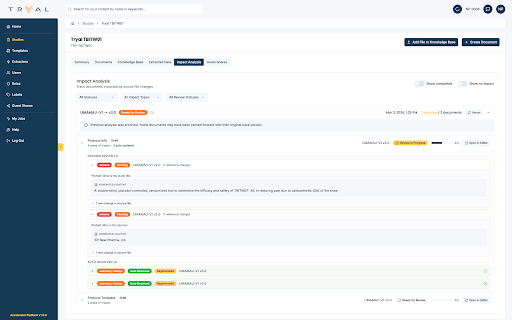
Figure 2: Impact Analysis results showing affected generated content and reference types
Step 3: Guided Section Review
When the user opens the document editor, Accelerator presents a clear notification: “5 sections are affected” (or however many). The right-hand panel displays exactly what changed in the source, giving the reviewer full context without having to toggle between documents. Rather than dumping a list of changes and leaving the user to figure out what matters, Accelerator walks them through each affected section with the relevant context already surfaced.

Figure 3: Document editor showing affected sections and source change context
Step 4: Three-Option Resolution
For each flagged section, the user has three options:
Option | Description |
No Change | The source changed, but the generated content is still accurate. Acknowledge the flag and move on. This decision is logged. |
Regenerate Text | Let Satori regenerate the section using the updated source content and the original prompt. The AI produces new text that reflects the current state of the Knowledge Base, maintaining the document’s template structure and style. |
Manually Update | Edit the section by hand. This is essential for sections where regulatory nuance, site-specific context, or legal language requires human judgment that goes beyond what the source change alone would dictate. |
Step 5: Auditable Resolution
Every decision—whether to keep, regenerate, or manually edit—is recorded. The system maintains a distinction between system AI-generated text (marked in blue) and when that text has been manually edited(marked in orange). In regulated environments, knowing who or what produced a piece of content, if it was changed, and why, is fundamental to compliance.
Why This Matters: The Competitive Reality
Most document generation platforms in the clinical space stop at generation. They help you create the first version. But clinical trials do not operate in a world of first versions. They operate in a world of amendments, corrections, regulatory responses, and evolving study designs.
A platform that generates documents but cannot manage the lifecycle of those documents after generation is solving only half the problem—and arguably the easier half. The hard part is not creating a document. The hard part is keeping a portfolio of interrelated documents accurate, consistent, and audit-ready as the underlying reality changes.
Tryal Accelerator’s Impact Analysis addresses this gap directly. By maintaining a living reference architecture between source content and generated outputs, Accelerator transforms document management from a reactive, error-prone process into a proactive, guided workflow. The result is a reduction of over 90% in review hours per amendment cycle—converting what was 80 to 100 person-hours of manual review into a structured resolution process that takes a fraction of the time.
Built for the Regulated Environment
In clinical trials, the question is never just "did we update the document?" The question is: "can we prove we evaluated the impact, made an informed decision, and maintained consistency throughout our documents?"
Impact Analysis provides that proof. Every flag, every decision, every regeneration or manual edit is captured in the system’s audit trail. When a monitor asks why a particular section of an informed consent form reads the way it does, the answer is traceable: it was generated from this source, updated because of this change, reviewed by this person, and resolved through this action.
This level of traceability is not available in manual workflows. It is not available in platforms that treat documents as static artifacts. It is a direct consequence of Accelerator’s architecture—one that treats documents as living, connected entities rather than isolated files.
Configurable by Design
Impact Analysis is enabled at the organizational level and can be toggled on or off based on operational needs. When enabled, the feature runs automatically whenever a new version of a source document is uploaded.
The system is designed to support real-world workflows where multiple people may be responsible for different documents, where changes happen at unpredictable intervals, and where the cost of missing an impact is measured not in inconvenience but in regulatory findings and patient safety.
The Bottom Line
Impact Analysis in Tryal Accelerator represents a fundamental shift in how clinical document management works. It moves the industry from a model where every change triggers a manual, error-prone review across dozens of documents to one where the system itself understands what changed, what it affects, and guides the user through resolution.
This is not incremental improvement. This is the difference between a document generation tool and a document intelligence platform. Generation gets you started. Intelligence keeps you accurate.
For organizations managing complex clinical programs with frequent amendments, evolving regulatory landscapes, and distributed teams, Impact Analysis is not a nice-to-have. It is the feature that makes AI-powered document management actually work in production—not just for the first version, but for every version that follows.
Ready to see Impact Analysis in action? Schedule a demo with our team or create your own sandbox today

Comments